
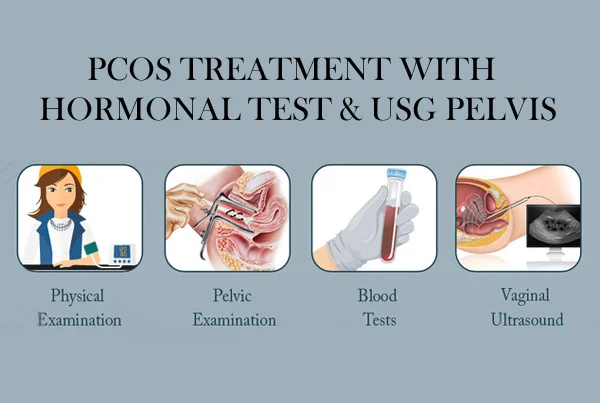
| Category | PCOD Treatment with Hormonal Tests & USG Pelvis |
Hormonal Test
To assess the frequency of abnormal values for hormone measurements commonly used in the biochemical diagnosis of polycystic ovary syndrome (PCOS).
Hormone measurements in 63 unselected women with clinical and ultrasound diagnosis of PCOS attending gynecological and general endocrine clinics in a District General Hospital were compared with those from a group of 20 normal ovulatory controls in the early follicular phase of their cycles.
Serum levels of luteinizing hormone (LH), follicle-stimulating hormone (FSH), LH/FSH ratio, total testosterone, derived free testosterone, sex hormone-binding globulin, androstenedione, and dehydroepiandrosterone (DHEA) were measured by radioimmunoassays. LH and FSH were measured by two different assays.
USG Pelvis
USG Pelvis produces pictures of the internal structures and organs of the area by using high-frequency sound waves. To conduct a USG Pelvis, a small probe known as transducer and gel is applied on the skin directly, to allow the high-frequency sound waves from the transducer to travel from the probe into the skin to produce real-time images of the area, as well as the movement of the organs and blood flow in the blood vessels. Unlike X-rays, ultrasounds do not use radiation. In some cases, the doctors might use the Doppler ultrasound technique, which is a specialized ultrasound technique used to determine the movement of materials such as blood flow through arteries and veins.
What is the use of USG Pelvis?
USG pelvis is a pain-free, non-invasive diagnostic test that is used to examine critical organs in both men and women.
Particularly in women, a USG pelvis is used to study the:
In men, a USG pelvis is used to study the:
Why is USG Pelvis important?
A USG Pelvis may be recommended to detect for certain health conditions or in other cases, to assess the health and growth of an embryo or fetus.
A USG Pelvis in women is recommended to diagnose any of the following:


